In order to produce my final short film I went through
several stages of audience research in order to improve my product and to
confirm a target audience for the product as a whole including the ancillary tasks.
Initially I wanted to research into my target audience that I thought would be
appropriate for the piece that I wanted to create. This was the 15-25
demographic with a slight lean towards the female sex compared to the male. In
order to confirm this proposed target audience I asked two different groups of
people the simple question
Would you go and see this film?
The two groups were,
YOUNGER – 20, 15 – 25 year olds mainly composed of people in my year at
school so they were mostly 16-18
OLDER – group of 10 people from 40 – 60 mainly parents of my
friends.
And these were the results,

Younger

Older
As you can see there was a definite split between the two
age groups with those of a similar age to me who definitely fit into the 15 –
25 demographic mostly stated an interest in the film concept which gave me
confidence that my planned target audience was the right one. While the second
group of those of an older age is small and the results aren’t that promising I
thought that this was useful to carry
out to see if possibly the film could have a wider audience however this hope
was short lived as it became clear from this small sample that there was not
much interest from this older age group.
However if I were to do this again I would also have made
note of the gender of these people as this as something that was relevant to my
target audience research but was not something I focused on which limited the
success of this initial research.
After I had begun to put together several edits of the film
I began to show them to several people in order to receive some feedback on how
the film was progressing.
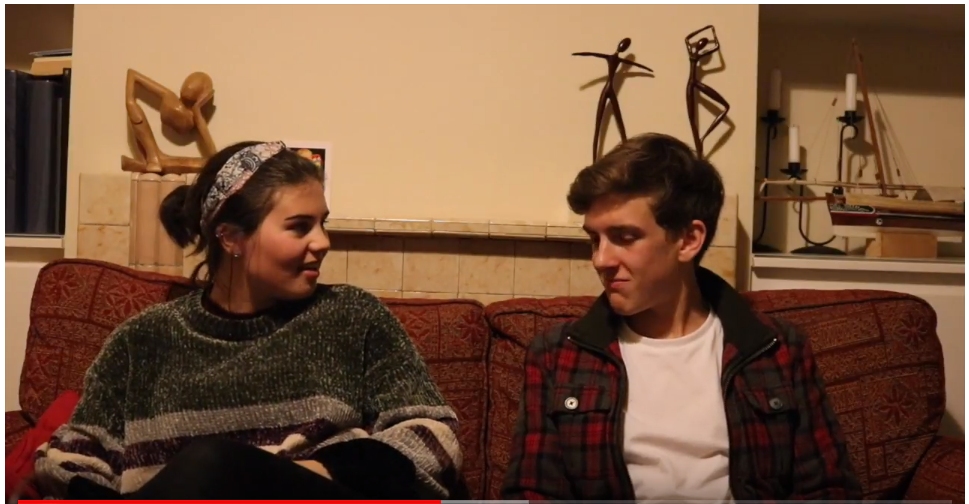
With the first round of audience feedback the biggest piece
of feedback I received was that a shot reverse shot between Ottilies character
and Roddies character didn’t make sense in terms of the 180 degree rule
something I hadn’t payed enough attention to during filming and so the feedback
was incredibly important in catching this mistake that I went on to fix in a
series of reshoots. The problematic shot is shown below along with the shot I
changed it for during reshoots.
I performed several further pieces of audience research where
I asked people to look at the later stages of production as the piece began to
came together. This was useful for a couple of reasons. Firstly they were useful
because they showed me a different reading of the text that I hadn’t intended for
there to be. One person thought that Roddies character was far more
antagonistic than I had actually planned and this was interesting because it
suggested that I had not made him as sympathetic as I would have intended
possibly due to the restrictions of the format and the limited number of lines
I could give him in the time allowed for the piece
Secondly it was also useful in terms of production because
again it helped to highlight failures in the earlier pieces of the production
such as particular issues with sound for example with the beginning of the
piece the decision to have the opening of the fridge cut into the music cue of
the production company logo and this definitely added to the effectiveness of
the opening as it gave a sense of falling directly into the setting of the piece.
Furthermore they helped with continuity
such as one scene where the décor behind one of the characters changed between
shots .
These became particularly important when filming reshoots as I had to
make sure that costuming and setting were all kept the same throughout shoots
something that I nearly managed to achieve although there were still a couple of
continuity errors.
The last bit of audience research I performed was after I
had completed the final edit of the piece. To do this I created a short survey
which I gave to 10 people who watched
the film. I used a mixture of long form and multiple choice questions which
gave me a mixture of qualitative and quantitative data and it was all useful.
The survey can be seen below,
In terms of audience this survey was fairly useful as it
confirmed the findings of my earlier research that suggested that the main audience
demographic would be the 15 – 25 age range this was clearly true as, in terms
of enjoyment, people rated the film on average a 7/10 and the average age of the people completing
the survey was 17 further showing the accuracy of my predicted age range.
However it must be noted that everyone rated the film fairly highly including
those that were not a part of this particular demographic suggesting that the
piece has a wider appeal than I had originally thought.
In terms of things that I did well, several people commented
on how successful the overall cinemaphotography was in the piece for example
one person commented that they like this particular shot (see below) of the two
main characters in particular which shows that my cinemaphotography was
successful
In addition to this when asked about how cohesive the
narrative was many people said that they thought that it was cohesive and worked in the time frame a very good result especially considering the limited time frame that this product uses. I was afraid that the narrative would seem rushed or somewhat limited but nobody suggested that this was the case. #
Furthermore, when
asked if they thought the characters were stereotypical many people said that they were not and that they were well nuanced and seemed to be natural this is especially important to achieve in a coming of age film as it had to be grounded in realism. This was very useful as it showed how effective my script had been in creating two characters that appeared realistic to an audience of people who are supposed to be the same age as the characters.
Finally people mostly said that they either greatly enjoyed
the music or felt that it didn’t add much to the piece overall . On the one
hand this is clearly good news because it would have been bad if people had
said that they had not enjoyed the music of the piece because this was a
central focus of mine during the production process. However it would have been
nice to have had universally positive feedback and this lead me to think that I
could have used the soundtrack more creatively because people particularly
liked the ending soundtrack and so if I had used music to convey emotions more
this could have benefited the overall product.
However many people did comment that the diegetic sound varied
drastically and this made the viewing experience worse. One person commented
that this was because they couldn’t hear certain bits of dialogue because of
the non diegetic sound being to loud or because the actual audio for the
dialogue was too quiet. Another person said that they couldn’t hear people
speaking because of background noise such as airplanes and cars when filming
outside of the house. These comments clearly show a major flaw in my product
that is especially annoying for me as I had tried to fix these issues and had
thought I had done a good job but it was clearly not good enough.
In terms of audience feedback for my ancillary tasks I
performed a series of vox pops where I simply asked for peoples opinions when
it came to both my poster and my magazine double page spread. An example of
these can be seen below
Several common themes emerged as I was performing these
In terms of the poster, people really liked the layout that
I went for in particular the placement of the image and the way in which the
text surrounded the two actors shown in it. They also liked the use of the
slowly fading away question marks as a part of the title. It was also good that
several people who had seen both the film and the poster noted that the texts
used at the end of the film was the same as that used in the poster title which
was a definite plus.
However there were several things that people didn’t like.
The primary issue that many people had was that once I had printed out the
poster the awards that I had placed on the right hand side of the poster became
lost in the background of the image which meant they were very difficult to see
from a long distance away limiting the posters effectiveness. In addition to
this people had mixed feelings about the choice of colours in the poster and
thought that maybe there could be a great variety of colours used in the text
rather than just the black and white that I had used
In terms of the magazine article people particularly liked
the images used and the way they were displayed with people saying they were
visually interesting as well as engaging. People who also thoroughly read the
text said that they enjoyed reading it although several people choose not too
as I caught them at a moment where they were somewhat busy which did limit the
usefulness of this research to a certain degree. Finally a few people noted
that they liked the side panel with the various bits of information in it which
was great as this was something I put a great deal of time into especially when
designing the stamp and rating system logos
However there were some things that people either didn’t
like or had mixed feelings about. The main complaint that several people had
was that the text as a whole was somewhat bland with people particularly
pointing out that the title of the text wasn’t as eye catching as they would
have liked. In addition to this some people thought that the main body of text
was too small and therefore difficult to read something that I could not judge during
production as I was not reading it in print.
Overall throughout
the whole production process I believe I have benefitted greatly from my
audience feedback. In the early stages of development it was useful in
highlighting production failures that I might have missed and this helped to
guide my production especially when it came to colour correction and editing
decisions or when eventually deciding to reshoot. In the later stages of
development and when the piece was complete it was particularly useful as it
highlighted to me the particular bits of the main task that I had achieved
successfully and some pieces that I had not. This wasn’t as useful as I was
focusing on evaluation once this had been completed but it was very reassuring
as it confirmed that I had made a piece that effectively targeted a particular
audience and was enjoyable for all those who viewed it.




 - Comedy 9
 -Yes 12


